
Seen “FYM” pop up in a text and paused mid-scroll? You’re not alone — this short slang term shows up everywhere, from casual texts to Instagram comments, and it can feel confusing if you weren’t raised on internet shorthand.
This guide breaks down exactly what FYM means, how tone changes everything, and when it’s okay (or not) to drop it into your own conversations.
Quick Answer (Featured Snippet Optimized)
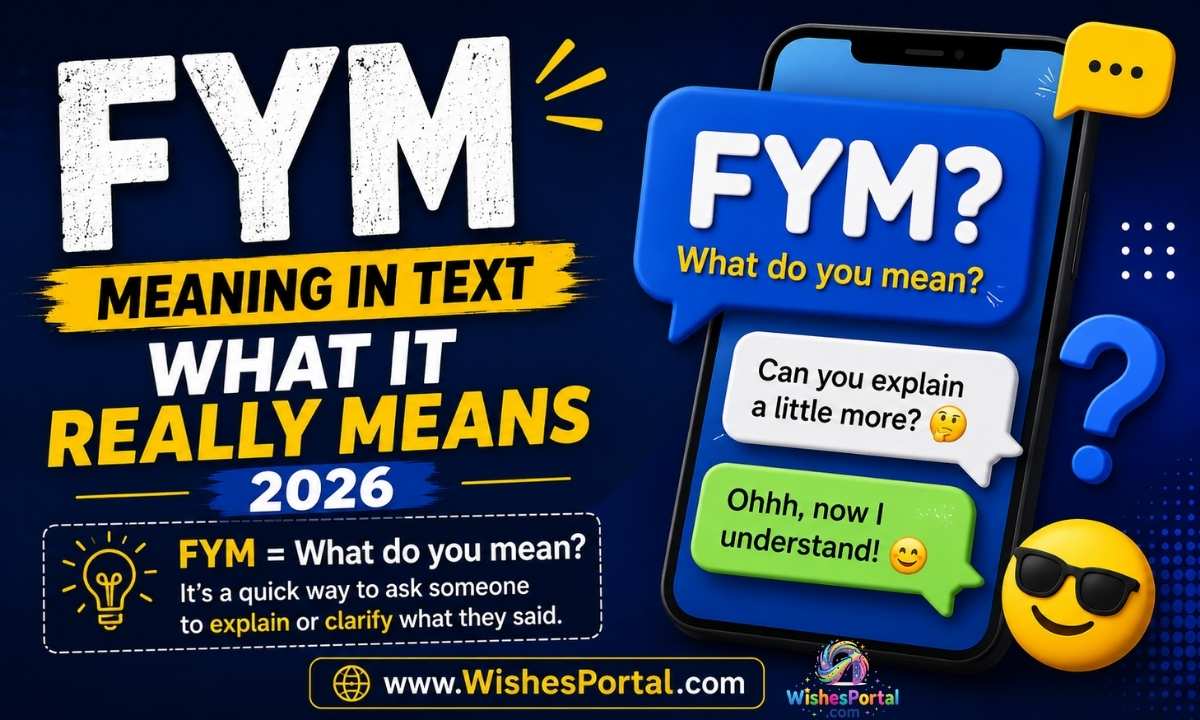
FYM stands for “F*** You Mean?” — a popular texting abbreviation people use when they’re confused, surprised, or can’t quite understand what someone just said. In most cases, it’s simply a shorter, more direct way of asking, “What do you mean?” Depending on the situation, though, it can come across as playful, casual, or a little rude.
Like many internet slang terms, FYM became popular because it saves time. Instead of typing out a full question, users can respond with just three letters, making conversations in group chats, social media comments, and direct messages feel quicker and more natural.
As more people communicate through text instead of phone calls, searches for terms like “FYM meaning,” “what does FYM mean in text,” and “FYM slang definition” continue to rise. Today, FYM sits alongside other common abbreviations that help keep online conversations short, expressive, and fast-paced.
Common meanings of FYM:
• F*** You Mean — the most widely used meaning across texting and social media
• For Your Information — a rarer, less common alternate use
• Following Your Mind — an uncommon variation seen occasionally in gaming or niche chat groups
What Does FYM Mean in Text?
Before getting into platforms and tone, it helps to understand the basic mechanics of why this phrase even exists in the first place.
Simple Explanation:
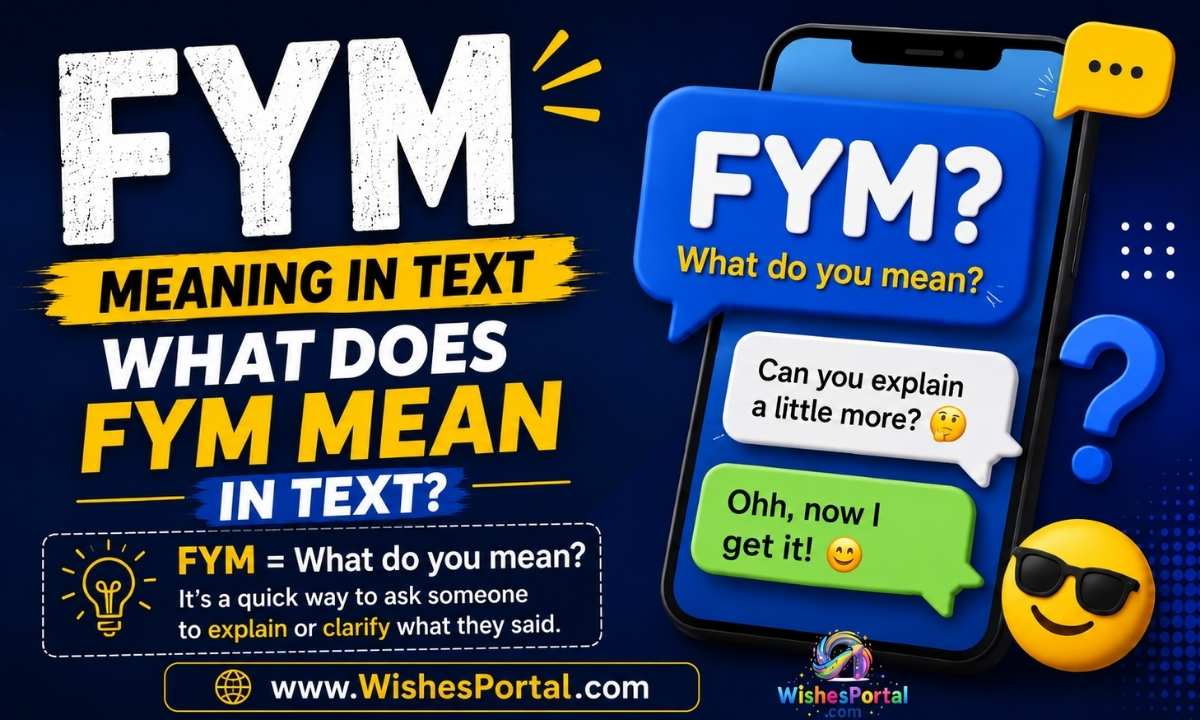
At its core, FYM is a reaction. When someone says something confusing, unexpected, or a little hard to understand, the other person might reply with “FYM” instead of typing out a full question. It’s quick, casual, and gets straight to the point. Think of it as the texting version of saying, “Wait, what?” For people trying to keep up with fast-moving group chats, that speed is part of the appeal.
Unlike many internet acronyms, FYM doesn’t carry just one emotion. It can be playful between friends, genuinely curious in a casual conversation, or come across as sharp and confrontational during an argument. The letters never change, but the tone behind them can shift dramatically depending on who sends them and the context of the conversation. That flexibility is one reason the abbreviation has remained so popular.
It’s also worth noting that FYM is usually a response rather than a conversation starter. People rarely open a chat with it. Instead, it’s used to react to something that was already said, which means the message before it is just as important as the acronym itself.
Experts who study digital communication often point out that text messages lack the tone of voice, facial expressions, and body language we rely on in face-to-face conversations. That’s why online slang terms like FYM often depend on punctuation, capitalization, and emojis to communicate emotion. The exact same message can feel friendly, confused, or aggressive based on those small details.
Like many texting abbreviations, FYM evolved from everyday spoken language. As conversations moved to smartphones and social media, people naturally shortened common phrases to save time and keep up with the pace of online communication. Over time, FYM became more than just an abbreviation—it turned into a widely recognized piece of internet slang with a meaning all its own.
Mini Examples:
A few quick snapshots make the pattern even clearer, since each one shows a slightly different shade of the same basic reaction:
• “FYM you’re not coming to the party?” — surprised, slightly disappointed
• “FYM that?” — quick clarification request
• “FYM ‘it’s fine’” — pushing back on a vague answer
• “FYM lol” — lighthearted, joking confusion
• “FYM did you really say that out loud” — amused disbelief
• “FYM no way that actually happened” — shocked, almost impressed
Where Is FYM Commonly Used?
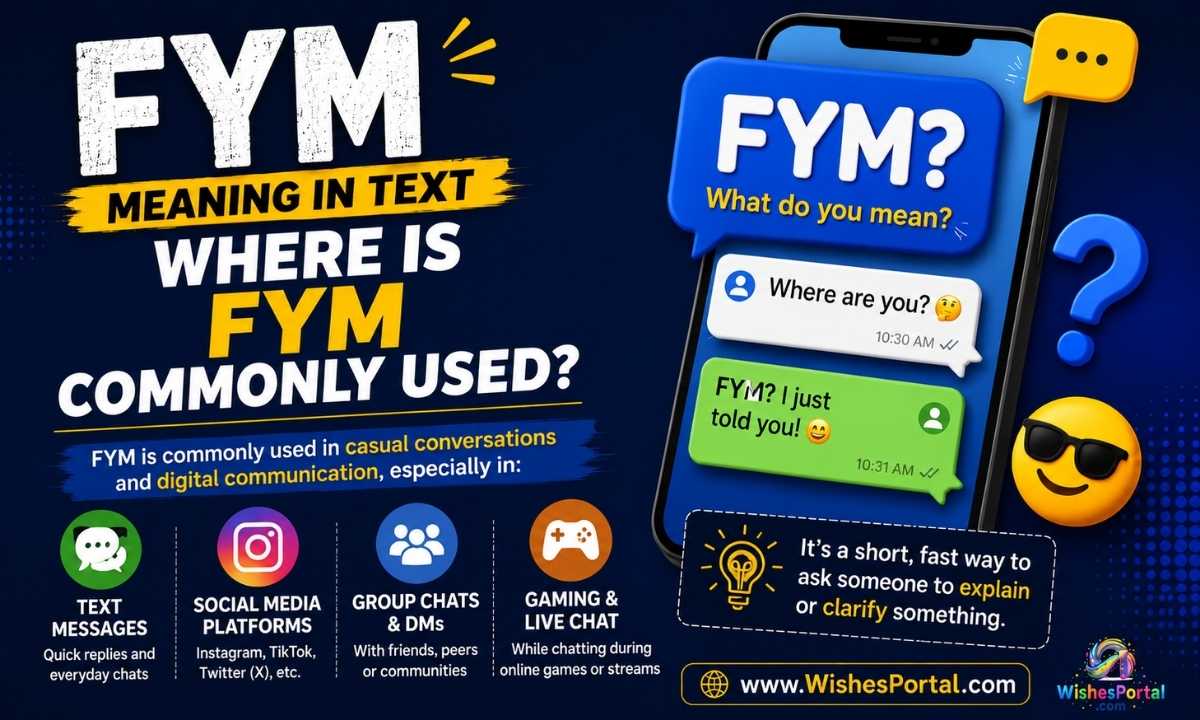
FYM isn’t locked to one app. It travels across nearly every platform where fast, informal typing is the norm, since the whole point of the phrase is speed and convenience. That said, the vibe can shift slightly depending on where it’s used and who’s reading it, since each platform comes with its own unspoken texting culture and audience expectations.
Text Messages
In regular SMS or iMessage threads, FYM usually pops up between close friends or in heated group chats. It’s direct, fast, and assumes the other person already understands the tone behind it because of the history between them.
Since WhatsApp is popular for both casual chats and family or friend groups, FYM here tends to lean more playful, often softened with emojis, voice notes, or a quick laughing follow-up message.
Snapchat
On Snapchat, FYM often appears in quick chat replies tied to a snap or story, usually reacting to something unexpected someone just shared, like a surprising photo or an out-of-nowhere update.
In Instagram comments and DMs, FYM frequently shows up as a reaction to a confusing caption, a surprising post, or a comment that needs clarifying before the conversation can continue.
TikTok
TikTok comment sections are full of FYM, usually reacting to a plot twist in a video, a confusing trend, or a comment that seems to contradict the video it’s sitting under.
Gaming / Discord
In gaming chats and Discord servers, FYM often shows up mid-match, usually fired off fast when a teammate makes a confusing call or an opponent pulls off something unexpected on screen. Voice chat overflow into text channels also means FYM frequently gets typed out during replays or post-match recaps.
Across every platform, the underlying rule stays the same: the closer the relationship and the more casual the setting, the more naturally FYM fits into the conversation without raising eyebrows. The moment a stranger or a formal setting enters the picture, that same comfort disappears fast.
Tone and Meaning Explained
Because FYM has no built-in punctuation rules, tone almost entirely depends on context, capitalization, and what came before it in the conversation. Here’s a quick breakdown of how the same four letters can land in three completely different ways:
Tone How It Sounds Typical Use?
Friendly Light, joking, often paired with “lol” or an emoji Between close friends or playful banter
Neutral Genuine confusion, no real attitude attached Asking for quick clarification
Rude / Cold Short, sharp, sometimes followed by silence Arguments or annoyed reactions
A few quick signals can help you judge tone before you even reply: capital letters and missing punctuation usually mean more intensity, a fast reply time often signals strong emotion either way, and an emoji attached almost always softens the message into something friendlier. The same logic applies in reverse — a slow, delayed reply paired with a bare “FYM” often means the sender took a moment to cool off before typing.
Friendly Tone
“FYM 😂 you actually did that?” reads as amused disbelief, not anger. The emoji and exclamation soften it instantly, and friends usually reply with more laughter rather than an explanation.
Neutral Tone
“FYM, can you explain again?” is simply someone asking for clarity, with no hidden attitude involved. It functions almost exactly like typing “sorry, what do you mean?”
Rude or Cold Tone
“FYM.” with a period and nothing else often signals irritation or genuine annoyance, especially in a tense conversation where the sender feels like they’ve already explained themselves.
Examples of FYM in Conversation
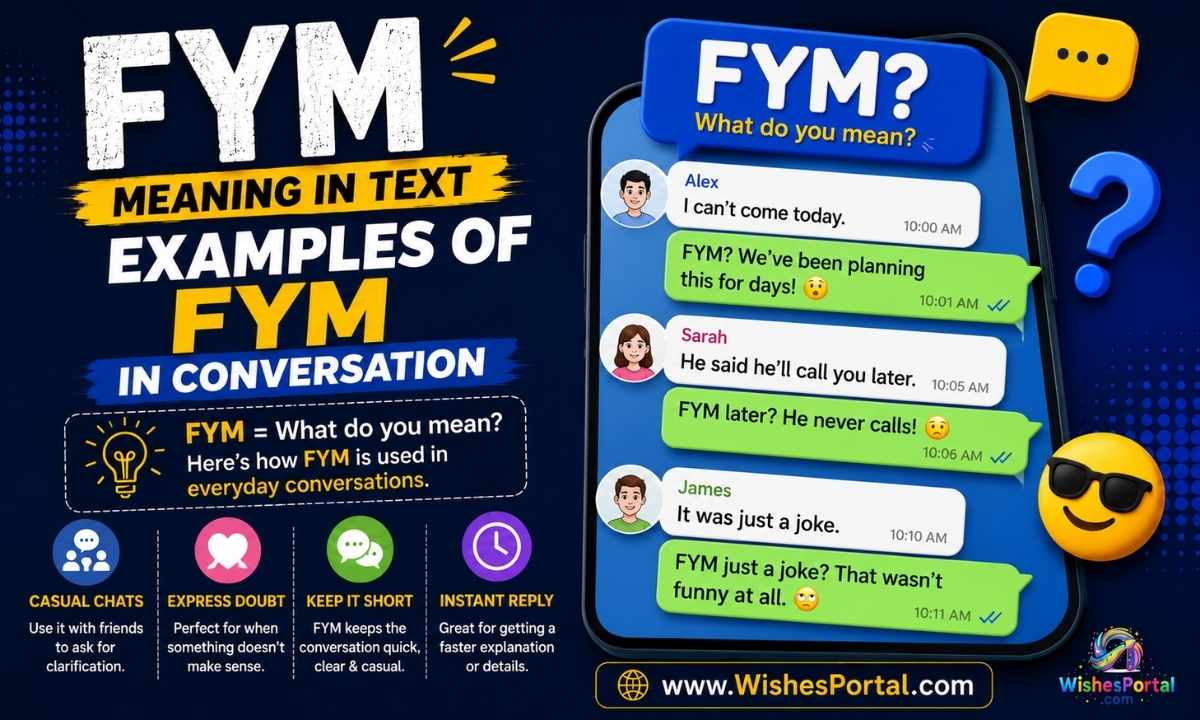
Seeing FYM in full conversational context makes the meaning click faster than any definition alone, since the words around it carry most of the emotional weight.
• Friend A: “I forgot your birthday was today.” Friend B: “FYM you literally posted about it last week”
• Person A: “I’m not mad, I’m just disappointed.” Person B: “FYM that’s worse”
• Group chat: “We’re leaving in 5.” Reply: “FYM you said 30 minutes ago”
• Comment section: “This movie is overrated.” Reply: “FYM it’s a classic”
• Sibling text: “I ate the last slice.” Reply: “FYM that was mine”
• Coworker chat: “Meeting got moved to 9am.” Reply: “FYM nobody told me”
• Roommate text: “I used your charger and it broke.” Reply: “FYM how does a charger just break”
• Sports group chat: “They lost again.” Reply: “FYM they were up by 20”
Notice how the same word shows up in completely different situations — a birthday mix-up, a missed slice of pizza, even a rescheduled meeting — and yet it still reads naturally every time. That versatility is exactly why FYM has become such a default reaction online, working just as well for small annoyances as it does for genuinely shocking news.
FYM Meaning From a Girl
When a girl sends FYM, the meaning usually leans heavily on the relationship and the conversation’s mood right before it was sent, rather than the word itself carrying any fixed weight.
Curious / Playful
“FYM you’ve never seen that movie?? 😭” reads as light teasing, not actual irritation. It’s usually followed by more jokes rather than a serious follow-up question, and often turns into a longer bit about the topic.
Confused
“FYM I don’t understand what you’re saying” is straightforward, genuine confusion with zero hidden edge. It’s simply asking for the message to be repeated or rephrased, much like a verbal “huh?”
Upset or Defensive
“FYM I never said that” with no punctuation softening it usually signals real frustration or feeling misunderstood, especially if it follows a longer pause in replies or comes after a string of one-word answers.
FYM Meaning From a Guy
Guys tend to use FYM in slightly more clipped, direct ways, though context still drives the actual emotional weight far more than gender ever does.
Straightforward
“FYM what time we meeting” is just a quick, casual request for information, nothing deeper attached to it at all. It’s often the texting equivalent of a quick head-nod question.
Challenging
“FYM bro that’s not even close” pushes back on a claim, often during friendly debates, sports talk, or competitive gaming banter where a little trash talk is expected.
Casual
“FYM lmaooo” is purely reactive, expressing amused disbelief with zero real tension behind it whatsoever, usually triggered by a funny clip, meme, or unexpected plot twist.
Is FYM Ever Rude or Offensive?
Yes, FYM can come across as rude, but it depends entirely on delivery rather than the letters themselves. Since the full phrase contains a curse word, even a casual sender can unintentionally sound harsher in text than they intended out loud, especially with strangers who don’t know their usual texting style. Context, history, and timing all matter more than the abbreviation itself.
When It Feels Dry?
A one-word “FYM” with no emoji, no follow-up, and no punctuation often reads as cold, even if that wasn’t the sender’s intent at all. Silence after it tends to make the message feel even sharper.
Passive-Aggressive
Pairing FYM with a long delay before replying, or sending it right after being ignored, often signals quiet frustration rather than simple curiosity, especially in ongoing disagreements.
Polite Version
Adding context like “FYM, sorry I just didn’t catch that” instantly softens the phrase into something friendly and low-stakes for everyone involved, no matter how the conversation started.
When to Use and When NOT to Use?
Like most casual slang, FYM works great in the right setting and lands awkwardly in the wrong one. Here’s a simple way to gauge it before hitting send:
Good Times to Use FYM Times to Avoid It
Texting close friends casually Talking to a boss, teacher, or elder
Reacting to a funny or surprising update Formal emails or professional chats
Light teasing in a group chat Sensitive or emotional conversations
Gaming banter with teammates First-time conversations with someone new
Reacting to memes or funny posts Customer service or support chats
Catching up with old friends Conversations with family elders
A good rule of thumb: if you wouldn’t casually drop a mild curse word in front of that person out loud, it’s probably safer to skip FYM and type the full question instead. When in doubt, a slightly longer message almost always reads as more thoughtful than a clipped one-word reaction.
FYM Meaning in Chat vs Social Media
Although FYM means the same thing everywhere, the way it lands can shift dramatically depending on whether it’s private or public.
In Chat
Private texts and DMs allow more personal context, so FYM tends to be read more accurately based on the existing relationship between the two people involved, plus their usual texting habits, inside jokes, and shared history together.
On Social Media
In public comment sections, FYM is often read by complete strangers without any relationship context, which means it can come across more aggressively than intended, even when the original sender meant it lightly. Public visibility also means a wider audience may misjudge the tone entirely, since they have no prior conversation to compare it against. A reply on a celebrity post, for instance, reads completely differently than the same word sent privately to a best friend.
Similar Slang Words or Alternatives
If FYM feels a little too sharp for the conversation, plenty of close alternatives carry similar energy with slightly different intensity. Swapping in one of these can soften or sharpen the reaction depending on what the moment calls for:
Slang Meaning
WDYM What Do You Mean — a softer, more neutral alternative to FYM
HUH Plain confusion, with no attitude attached
SAY WHAT Surprised disbelief, similar energy to a friendly FYM
WAIT WHAT Genuine shock or confusion about new information
FR FR Often paired with FYM to emphasize disbelief (“FYM fr fr”)
NAH FR Disbelief mixed with mild disagreement, slightly more dismissive
ON GOD Used to back up a confused or surprised reaction with sincerity
Many of these terms get mixed and matched in the same conversation, which is part of what makes texting slang feel so alive and constantly evolving rather than fixed. Swapping FYM for a softer alternative is also a simple way to keep the same energy while dialing down the intensity.
Other Meanings of FYM
While the curse-word version dominates everyday texting, FYM occasionally stands for something else depending on the context it appears in. These alternate meanings rarely overlap with the slang version, since they tend to show up in completely different settings:
• For Your Money — sometimes used in finance or business slang
• For Your Music — occasionally seen in music-sharing communities or playlists
• Fix Your Mindset — used in motivational or self-improvement spaces
• Following Your Moves — a rare gaming-related variation
• Find Your Match — occasionally used in dating app or matchmaking contexts
These alternate meanings are far less common, so context clues almost always point back to the original, more popular definition. If FYM shows up as a reaction to something someone just said, it’s safe to assume the standard meaning applies; if it shows up in a caption, hashtag, or branded post, it’s worth checking the surrounding words before assuming.
Why Do People Use FYM?
FYM didn’t become popular by accident. It fits naturally into how people actually communicate online today, where speed and tone often matter more than perfect grammar. Understanding the reasons behind its popularity also makes it easier to predict where similar slang will show up next, since the same forces keep shaping how digital conversation evolves.
Fast Typing
Typing four letters is faster than typing a full question, which matters in quick-moving conversations and busy group chats where messages pile up fast. Every saved second adds up over hundreds of daily texts, and on a phone keyboard, fewer taps genuinely change how a conversation feels in the moment.
Internet Culture
Slang spreads fast online, and once a phrase like FYM catches on through memes, comment sections, and viral videos, it sticks around for years and gets passed down through new waves of users discovering it for the first time.
Convenience
FYM works as a one-size-fits-all reaction, covering confusion, surprise, and mild disbelief without needing extra words or a fully thought-out sentence. That flexibility is rare for such a short phrase.
Casual Vibes
Using slang like FYM signals familiarity and comfort, which is exactly why it shows up so often between close friends rather than in more formal or distant relationships. It’s less about the actual question and more about the relaxed shorthand two people share.
Frequently Asked Questions
1. What does FYM mean in a text from a girl?
It usually means genuine confusion or playful disbelief, with tone shaped by emojis or punctuation around it.
2. Is FYM rude to say?
It can be, since the full phrase contains a curse word, but among friends it’s rarely taken seriously.
3. What’s the difference between FYM and WDYM?
WDYM is a softer, neutral version, while FYM carries more attitude and casual edge.
4. Should I use FYM with someone I just met?
It’s best avoided with new acquaintances, since tone can easily be misread without established context.
Conclusion
FYM is a great example of how texting is about more than just words—it’s about tone. Once you learn to pick up on context clues like punctuation, emojis, and your relationship with the person you’re messaging, it’s much easier to understand what someone really means when they use it.
Like most internet slang, FYM will continue to evolve as online communication changes. But its core purpose isn’t going anywhere: it’s a quick, honest reaction to something confusing, surprising, or unexpected. In a world of fast-moving chats and instant replies, that’s exactly why it remains so popular.




1 thought on “FYM Meaning in Text: What It Really Means in 2026”