
Last names from the 1800s have a timeless charm that modern surnames often lack. Whether you’re writing a historical novel, researching your family tree, creating a character, or searching for a vintage-inspired name, nineteenth-century surnames offer history, personality, and lasting appeal.
From strong occupational names to elegant Victorian-era family names, this collection features more than 199 fascinating surnames from the 1800s. Organized by category, it makes it easy to find the perfect name for your project.
✅ Quick Checklist Before Choosing a Team Name
Before diving into the full list, use this quick checklist to narrow down which type of 1800s surname fits your specific purpose — whether that’s fiction, genealogy, gaming, or creative branding.
This step saves time and helps you land on a name that genuinely feels right rather than just sounds old.
| Question | What It Tells You |
| Is the name for fiction or real use? | Fictional names can be more unusual; real-use names need broad appeal |
| What era within the 1800s? | Early 1800s names differ from late Victorian names |
| What nationality or region? | English, Irish, Scottish, American, and European names each have distinct flavors |
| Does it need to sound wealthy or working-class? | Class signals were embedded in Victorian surnames |
| Is it for a male, female, or neutral character? | Some surnames lean strongly gendered |
| How will it sound spoken aloud? | Test every surname by saying it out loud three times |
| Does it pair well with a first name? | The combination matters as much as the surname itself |
Once you’ve answered these questions, the right category will stand out immediately. Now, onto the names.
📜 Classic 1800s Last Names
Classic surnames from the 1800s are the bedrock of the era — recognizable, solid, and endlessly versatile. These are the names you’d find in census records, church registers, and old newspapers from both sides of the Atlantic.
They’re popular because they work in almost any context — historical fiction, family naming traditions, character creation, and vintage branding alike.
- Ashworth — A strong English surname meaning “ash tree enclosure,” common throughout northern England in the 1800s.
- Blackwell — Evocative and dark in tone, widely used across the American South and British Midlands.
- Caldwell — A Scottish-origin surname meaning “cold stream,” associated with respectable middle-class families.
- Davenport — Tied to a town in Cheshire, England, this name carried considerable social weight.
- Everett — An Anglo-Saxon name meaning “brave boar,” common across New England genealogy records.
- Fletcher — Originally an occupational name for arrow-makers, it became a widespread family name by the nineteenth century.
- Goodwin — Meaning “good friend” in Old English, this warm-sounding surname appeared frequently in 1800s American records.
- Hartwell — A place-derived name suggesting refinement and rural English roots.
- Irving — Popular in both Scottish and American contexts, famously associated with writer Washington Irving.
- Jennings — A patronymic surname common in Wales and England, widely recorded in nineteenth-century registers.
- Knightly — Evocative of chivalry and social standing, this surname carried aristocratic associations.
- Langford — A geographic surname meaning “long ford,” found frequently in Victorian census documents.
- Merritt — An English surname with roots in the word for “boundary gate,” popular in nineteenth-century America.
- Norwood — Meaning “north wood,” this surname was common across both British and American records.
- Pemberton — A distinguished surname tied to a Lancashire town, often associated with upper-middle-class Victorian families.
🎩 Elegant Victorian-Sounding Last Names
The Victorian era had a particular aesthetic when it came to surnames — layered, musical, and slightly theatrical. These names sound like they belong in a drawing room, a Jane Austen-adjacent novel, or the calling card of someone who owns a country estate.
Elegant Victorian surnames tend to feature soft consonants, longer syllables, and references to nature, places, or noble lineage.
- Ashbourne — Refined and place-derived, this name conjures images of English countryside estates.
- Beaumont — French in origin, meaning “beautiful mountain,” it was adopted widely by English-speaking families as a marker of sophistication.
- Cavendish — One of the most distinguished Victorian surnames, associated with the Duke of Devonshire’s family.
- Delacroix — French origin meaning “of the cross,” it carries an unmistakable elegance in any century.
- Elsworth — A softer, gentler surname that sounds quietly wealthy without being ostentatious.
- Fairfax — Meaning “fair hair” in Old English, this surname sounds both noble and approachable.
- Greystone — Architectural and atmospheric, this surname sounds like it belongs to a manor house.
- Harrington — A popular aristocratic-sounding surname with genuine English nobility connections.
- Islington — Place-derived and instantly Victorian in tone, associated with a well-known London district.
- Kensington — Royal in association and unmistakably nineteenth-century British in feel.
- Langley — A soft, musical surname meaning “long meadow,” common in both Britain and colonial America.
- Montague — Shakespearean and enduringly elegant, this surname never loses its romantic power.
- Northcott — Meaning “northern cottage,” it sounds grounded yet quietly refined.
- Pembridge — Rare and beautiful, this surname sounds like it belongs to a Victorian heiress.
- Ravenswood — Atmospheric and literary, this name evokes gothic Victorian fiction brilliantly.
🌟 Unique 1800s Last Names
Not every surname from the nineteenth century was a common one. Census records, ship manifests, and old church records are full of genuinely unusual surnames that deserve a second look. These unique 1800s last names stand out without feeling invented.
- Allsop — An English surname of uncertain origin, rare enough to turn heads but historically authentic.
- Brinsmead — An old Devon surname, deeply rooted in English rural history and almost never seen today.
- Casement — Meaning “window frame,” this occupational surname was unusual even in its time.
- Devereux — A Norman-origin surname meaning “from Évreux,” it was rare, distinguished, and unmistakably unique.
- Eldershaw — Meaning “elder tree wood,” this surname has a quietly magical quality to it.
- Fenwick — A Northumbrian surname associated with a village in Northumberland, rare and distinctive.
- Garnett — Tied to the gemstone, this surname was uncommon in the 1800s and remains so today.
- Havelock — Made famous by British General Henry Havelock, this surname is bold and historically loaded.
- Inglesby — A Scandinavian-influenced English surname meaning “Englishman’s settlement,” rarely seen.
- Jubilee — Occasionally used as a surname in the Victorian era, particularly after Queen Victoria’s Jubilee celebrations.
- Kitteridge — An unusual English surname with a musical rhythm and no obvious modern equivalent.
- Lorimer — An occupational surname for a maker of horse equipment, rare and wonderfully specific.
- Mossgrove — Nature-derived and poetic, this surname sounds invented but appears in old records.
- Nettleship — A wonderfully odd English surname found in Victorian registries, entirely authentic.
- Oulton — A place-name surname from Norfolk and Cheshire, rare and historically grounded.
😄 Funny & Quirky 1800s Last Names
The nineteenth century wasn’t short on surnames that make modern readers do a double-take. Many of these names were perfectly normal at the time — occupational, geographic, or descriptive — but land very differently today. These are the names that writers love for comic characters and genealogists discover with delight.
- Bumble — Yes, this was a real surname. Dickens borrowed it for Mr. Bumble in Oliver Twist, which tells you everything.
- Codfish — An occupational nickname-turned-surname, primarily found in coastal New England communities.
- Drinkwater — A genuine English surname, possibly given to a teetotaler or someone who lived near a clean water source.
- Egg — Recorded in Victorian England as an actual family surname. No explanation survives.
- Finch — Charmingly bird-like, this surname appears everywhere from English villages to American literary history.
- Gotobed — A real surname found in English census records, presumably the ancestor of very sensible people.
- Hogg — An occupational surname for pig farmers, common in Scotland and northern England.
- Inkpen — A place-name surname from Berkshire, England, that sounds like a Victorian stationery shop.
- Jollyboy — Occasionally recorded as a surname in 1800s registers, presumably belonging to someone very cheerful.
- Kettlewell — A place-name from Yorkshire that sounds like something you’d hear in a Dickens novel.
- Leaky — A genuine English surname, origin unclear, cheerfulness guaranteed.
- Merry — Common enough in the 1800s, this surname always brings good energy to any character list.
- Oddly — Found sporadically in old census records, and no, we’re not making this up.
- Pott — A short, punchy occupational surname for a potter, common in English Midlands records.
- Quirke — An Irish surname meaning “heart,” it sounds deliberately eccentric in the best possible way.
💎 Elegant 1800s Last Names
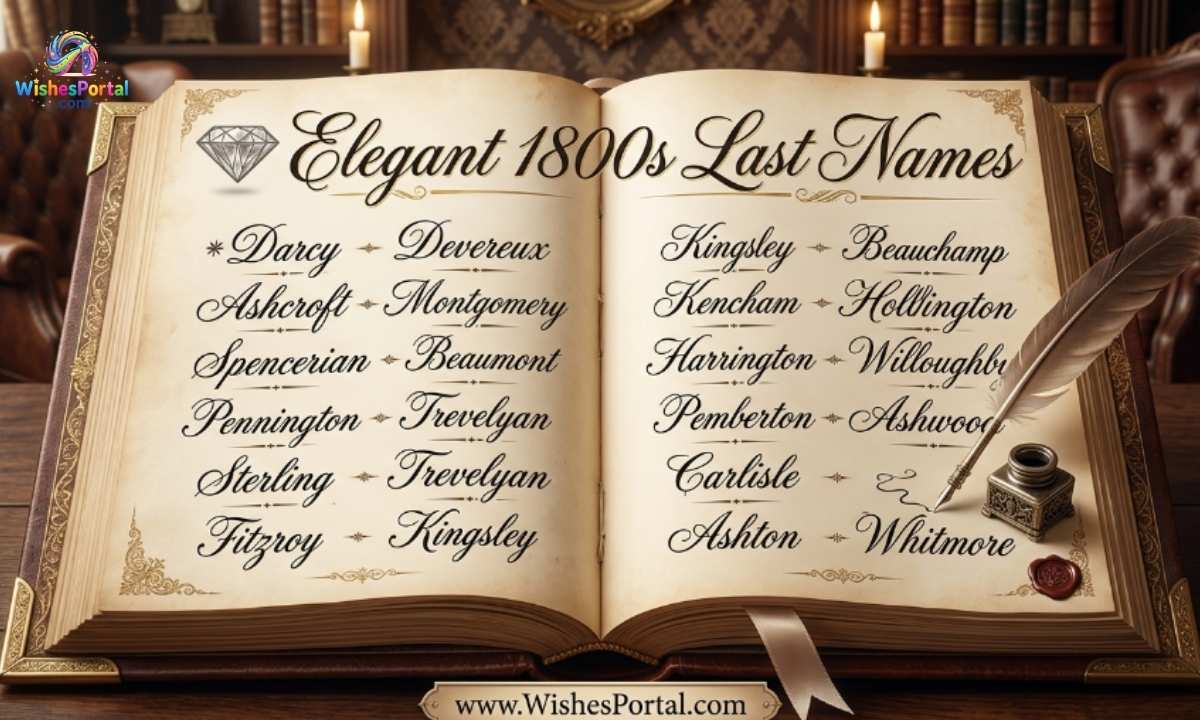
Beyond the Victorian category, there’s a broader pool of simply elegant surnames from across the 1800s that carry refinement in every syllable. These names feel timeless and distinguished without being exclusively tied to British aristocracy.
- Alderton — Soft, understated, and quietly distinguished.
- Belmont — French-origin meaning “beautiful mountain,” used widely across nineteenth-century America.
- Chalcott — Rare and refined, this name sounds like it belongs on a letterhead in copperplate script.
- Delwyn — A Welsh-origin name with a lyrical quality, suggesting sensitivity and artistry.
- Elbourne — An old English place-name that sounds calm, measured, and well-bred.
- Fairbourne — Meaning “fair stream,” this surname has the quiet elegance of the English countryside.
- Gracewood — Nature-meets-refinement in one beautiful compound surname.
- Hollingsworth — A substantial-sounding surname with deep roots in Lancashire and Pennsylvania records.
- Ivywood — Poetic and rare, this nature-derived surname has a distinctly nineteenth-century romanticism.
- Jasperfield — Gemstone meets landscape in this compound surname that sounds genuinely aristocratic.
- Kilvington — An old Yorkshire place-name with a dignified, multi-syllabic elegance.
- Larchmont — Place-derived, calm, and carrying the quiet prestige of old money.
- Meredith — A Welsh surname meaning “great ruler,” used by both men and women in the 1800s.
- Norcross — Meaning “northern cross,” this surname sounds resolute and refined in equal measure.
- Osbourne — Meaning “divine bear,” this Old Norse-rooted surname was widely used in Victorian England.
👦 Boyish 1800s Last Names
Some surnames from the nineteenth century carry an undeniably masculine energy — rugged, direct, and strong. These work brilliantly as last names for male characters in historical fiction or as given names in vintage-inspired modern naming.
- Archer — Occupational and strong, this name was common across both English and American records.
- Barrett — An Irish and English surname meaning “disputatious person” — perfect for a bold male character.
- Chase — Originally meaning “hunter,” this active, energetic surname feels genuinely boyish.
- Drake — Meaning “male duck” or tied to the Old Norse for “dragon” — either way, it’s bold.
- Emerson — Made famous by philosopher Ralph Waldo Emerson, this surname has intellectual, masculine energy.
- Ford — Simple, strong, and geographic — one of the most enduringly masculine Victorian surnames.
- Grant — Scottish in origin, meaning “large,” this surname was synonymous with strength and leadership.
- Hawke — Sharp and predatory in the best sense, this bird-derived surname has real boldness.
- Irving — Strong and literary, associated with the American author Washington Irving.
- Jasper — Both a gemstone and a rugged-sounding surname used in nineteenth-century American records.
- Knox — A Scottish surname meaning “round hill,” short, punchy, and unmistakably masculine.
- Lawson — A patronymic name meaning “son of Lawrence,” widely used in 1800s Britain and America.
- Mason — Occupational and sturdy, this surname has been consistently popular since the nineteenth century.
- Nash — Short and sharp, this English surname meaning “at the ash tree” suits a bold male character perfectly.
- Owen — Welsh in origin and widely used in the 1800s, this surname carries quiet but real strength.
👧 Girlish 1800s Last Names
Certain Victorian surnames carry a softness, romance, or elegance that makes them feel distinctly feminine — whether used as actual surnames or as first names with a vintage twist.
- Avery — A surname meaning “ruler of elves,” it was used for girls in the later 1800s and feels beautifully soft.
- Blair — Scottish in origin, this surname has a quiet, poetic femininity often overlooked.
- Clover — A nature-derived surname occasionally recorded in 1800s registers, perfectly gentle.
- Dove — Simple, soft, and symbolic — this bird surname has a deeply feminine elegance.
- Eden — Geographic and lyrical, this surname carries an almost mythical beauty.
- Flora — More commonly a first name, but recorded as a surname in Victorian census records too.
- Golding — Warm and golden-sounding, this surname feels delicate and distinctly feminine.
- Harper — An occupational surname for harp players, widely used by women characters in historical fiction.
- Ivory — A material-derived surname with warmth, rarity, and an unmistakably graceful sound.
- Jasmine — Rare as a surname but occasionally recorded, it remains one of the most beautiful options.
- Keeley — An Irish surname meaning “beautiful,” it suits a feminine character perfectly.
- Lark — A bird surname with a light, musical quality that feels inherently girlish.
- Mercer — An occupational surname for cloth merchants, it has a soft elegance in practice.
- Nightingale — The most romantic of all bird surnames, closely associated with Florence Nightingale.
- Pearl — Occasionally used as a surname in the Victorian era, it remains exquisitely feminine.
📖 Literary 1800s Last Names
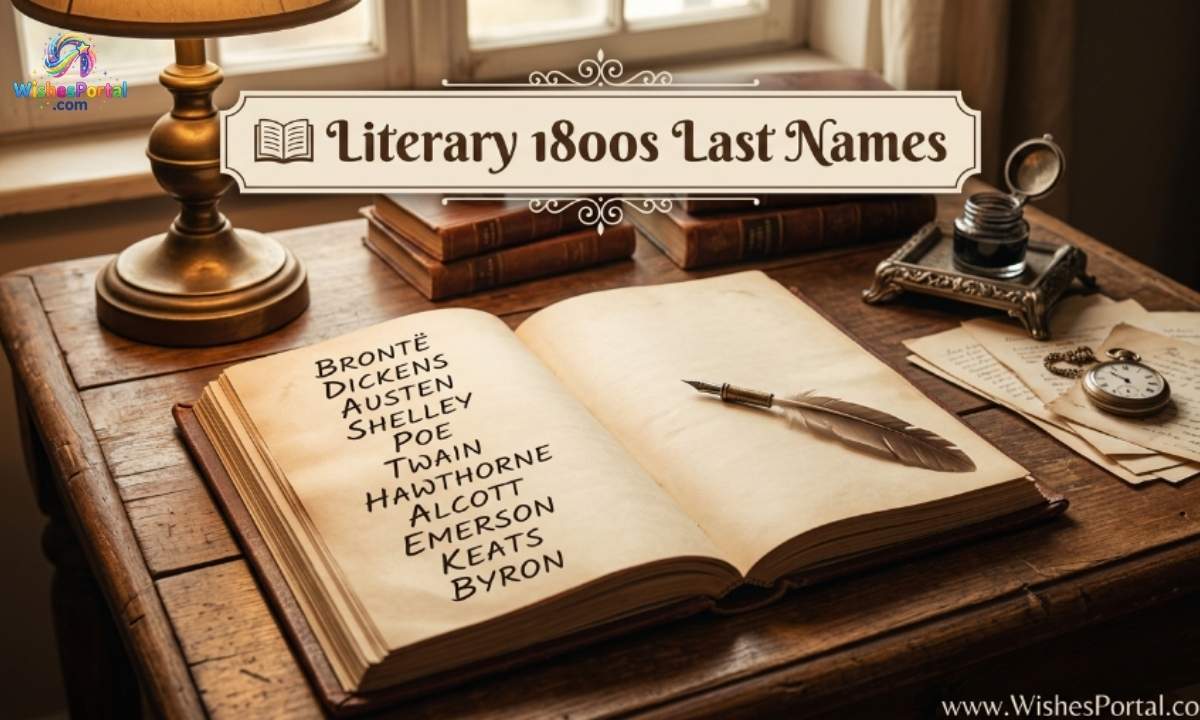
The nineteenth century produced some of the greatest literature in the English language — and the surnames in those novels, poems, and stories are unforgettable. These literary-inspired last names either appear in actual nineteenth-century works or carry the unmistakable flavor of the era’s fiction.
- Bennet — The beloved family surname from Jane Austen’s Pride and Prejudice (published 1813).
- Copperfield — Dickens gave this name to his most autobiographical hero in 1850.
- Dashwood — Another Austen surname, from Sense and Sensibility, elegant and literary.
- Earnshaw — The wild, tragic family at the heart of Emily Brontë’s Wuthering Heights.
- Fairfax — The surname of Jane Eyre’s eventual employer in Charlotte Brontë’s landmark 1847 novel.
- Gatsby — Not 1800s in publication (1925), but thoroughly rooted in Gilded Age late-1800s atmosphere.
- Heathcliff — The surname-used-as-given-name from Wuthering Heights, unforgettable and gothic.
- Ingram — A secondary character name in Jane Eyre, it carries aristocratic weight beautifully.
- Jekyll — Forever linked to Robert Louis Stevenson’s 1886 novella and its dark duality theme.
- Knightley — Mr. Knightley’s surname from Emma, suggesting moral uprightness and quiet strength.
- Linton — The refined family name contrasted with the Earnshaws in Wuthering Heights.
- Micawber — Dickens at his finest with character surnames, from David Copperfield.
- Nickleby — The surname of Dickens’ spirited Nicholas in Nicholas Nickleby (1839).
- Osborne — George Osborne’s surname from Thackeray’s Vanity Fair, suggesting flawed privilege.
- Pickwick — The wonderfully round and cheerful surname of Dickens’ famous Pickwick Papers protagonist.
🏛️ Historical 1800s Last Names
Beyond fiction, real history produced surnames attached to figures who shaped the nineteenth century. These historical last names carry genuine weight — each one tied to a real person who left a mark on the era.
- Lincoln — Abraham Lincoln (1809–1865), 16th President of the United States, the most iconic American surname of the 1800s.
- Darwin — Charles Darwin (1809–1882), whose surname became synonymous with scientific revolution.
- Nightingale — Florence Nightingale (1820–1910), the founder of modern nursing.
- Edison — Thomas Edison (1847–1931), the inventor whose surname means innovation itself.
- Dickens — Charles Dickens (1812–1870), whose surname defines Victorian literary culture.
- Austen — Jane Austen (1775–1817, died just before the 1800s but shaped it entirely).
- Emerson — Ralph Waldo Emerson (1803–1882), the philosopher of American individualism.
- Thoreau — Henry David Thoreau (1817–1862), whose surname evokes nature, solitude, and civil disobedience.
- Harriet (Tubman) — Tubman (c.1822–1913), whose courage defined an era.
- Douglass — Frederick Douglass (c.1818–1895), abolitionist, orator, and one of the century’s most important voices.
- Whitman — Walt Whitman (1819–1892), the poet who gave American literature its bardic voice.
- Brontë — The three Brontë sisters whose surnames defines gothic nineteenth-century literature.
- Tennyson — Alfred Lord Tennyson (1809–1892), Poet Laureate of Victorian Britain.
- Wellington — The Duke of Wellington (1769–1852), whose surname became synonymous with military triumph.
- Victoria — Queen Victoria (1819–1901), whose reign named the entire era and whose surname was Hanover, later Windsor.
⚒️ Occupational 1800s Last Names
Before modern naming conventions, many surnames came directly from what a family did for a living. These occupational surnames from the 1800s are some of the most historically grounded names on this list — each one telling a story of craft, trade, and labor.
| Surname | Original Occupation | Common In |
| Cooper | Barrel maker | England, America |
| Fletcher | Arrow maker | England |
| Miller | Grain miller | England, Scotland, America |
| Potter | Clay pot maker | England |
| Thatcher | Roof thatcher | England |
| Weaver | Cloth weaver | England, Wales |
| Carter | Cart driver | England, Ireland |
| Mason | Stoneworker | Across the English-speaking world |
| Turner | Lathe operator | England, America |
| Walker | Cloth fulling worker | Northern England |
Additional occupational surnames worth noting:
- Chandler — Candle maker or seller.
- Collier — Coal miner, common in Welsh and northern English records.
- Dyer — Cloth dyer, widespread in textile-producing regions.
- Fuller — Another cloth-working surname, common across England.
- Gardener — Self-explanatory, and widely recorded.
- Hunter — A gamekeeper or hunter, common across Scotland and northern England.
- Keeler — A boatman who operated on rivers and canals.
- Lister — A dyer of cloth, synonymous with Fuller in some regions.
- Naylor — A nail maker, common in the English Midlands.
- Sadler — A maker of saddles, found throughout horse-dependent nineteenth-century communities.
🗺️ Geographic 1800s Last Names
Many Victorian surnames derived from specific places — towns, rivers, hills, forests, and landscape features. These geographic last names feel rooted and real precisely because they are.
- Ashfield — From “ash tree field,” common across the English Midlands.
- Brookside — Meaning “beside the brook,” a pastoral English place-name surname.
- Clifton — Meaning “settlement by the cliff,” found in both British and American records.
- Dalton — From “valley settlement,” this surname was common in Yorkshire.
- Easton — Meaning “east settlement,” a simple and widespread geographic surname.
- Fenton — From “fen settlement,” tied to marshy English landscapes.
- Grafton — A place-name surname from multiple English counties.
- Halton — “Settlement in the nook,” found across Lancashire and Cheshire records.
- Ilton — A small village-derived surname from Somerset, England.
- Kingston — Meaning “king’s settlement,” associated with several English towns.
- Linton — From “linen settlement” or “flax enclosure,” a northern English place-name.
- Morton — From “settlement by the moor,” common across British and American records.
- Norton — Meaning “northern settlement,” one of the most frequently recorded geographic surnames.
- Overton — “Settlement on the riverbank,” found in multiple English counties.
- Preston — From “priest’s settlement,” tied to the Lancashire town and widely used as a surname.
🍂 Seasonal & Nature-Inspired 1800s Last Names
The natural world was deeply embedded in Victorian identity — and surnames reflecting seasons, landscapes, plants, and animals were common, poetic, and enduringly beautiful.
- Ashby — From the Old Norse for “ash tree farm,” this is a nature surname with Scandinavian roots.
- Birchwood — A compound name evoking silver birch woodland, peaceful and distinctly English.
- Coppice — Meaning a managed woodland, this surname is rare but genuinely nineteenth-century.
- Dawnay — Evocative of dawn, this surname carries a beautiful seasonal quality.
- Elmwood — Tree-derived and quietly elegant, perfect for a character with depth and roots.
- Frostwood — A wintery compound surname that feels both poetic and historically plausible.
- Greenleaf — Nature-derived and optimistic, found in American records from the early 1800s.
- Hawthorn — A hedgerow plant surname with deep English rural roots.
- Ivywood — Ivy-covered and romantic, this surname captures Victorian gothic atmosphere.
- Juniper — Occasionally used as a surname in the 1800s, it carries an herbal, wild quality.
- Kestrel — A bird surname occasionally found in Victorian records, sharp and uncommon.
- Larkspur — A flower surname that feels perfectly Victorian in its romantic, botanical quality.
- Moorfield — Landscape-derived, evoking open, wild moorland common in northern England.
- Nightshade — Dark, botanical, and unmistakably gothic — exactly right for certain characters.
- Oakwood — Solid, English, and deeply rooted — the oak has always symbolized strength.
👑 Wealthy Upper-Class Victorian Names
Class was everything in the Victorian era, and certain surnames signaled wealth, land, and social standing as clearly as an accent or address. These upper-class Victorian surnames carry the unmistakable weight of privilege, education, and old money.
- Ashford — Associated with English landed gentry, particularly in the south of England.
- Balmoral — Royal by association, tied directly to Queen Victoria’s Scottish estate.
- Cavendish — One of the great aristocratic surnames of Victorian England, tied to the Dukes of Devonshire.
- Devereaux — Norman in origin and exclusively upper-class in Victorian social association.
- Eton — Borrowed from England’s most famous public school, occasionally used as a surname.
- Fitzwilliam — The “Fitz” prefix in England traditionally indicated descent from nobility.
- Greville — A genuine English aristocratic surname, associated with the Earls of Warwick.
- Hartington — A courtesy title-turned-surname used within the Cavendish family.
- Inverary — Scottish aristocratic in feel, associated with the Duke of Argyll’s seat.
- Jermyn — Tied to London’s most exclusive shopping district, synonymous with upper-class taste.
- Kinnaird — A Scottish peerage surname of genuine aristocratic history.
- Lytton — Edward Bulwer-Lytton was a Victorian novelist and peer — this surname carries both literary and aristocratic weight.
- Montfort — Norman-origin, suggesting conquest-era descent and centuries of social standing.
- Northumberland — The county title occasionally used as a surname, unmistakably aristocratic.
- Pembroke — Associated with the Earl of Pembroke, one of the most enduring aristocratic titles.
📋 How We Create These Name Lists? (Step-by-Step Process)
Finding accurate, authentic, and usable 1800s surnames isn’t as simple as searching an online generator. Here’s the research process behind every name on this list:
Step 1: Primary Historical Research Names are sourced from actual census records, genealogical databases, ship passenger manifests, and church registries from the nineteenth century. The goal is authenticity above all.
Step 2: Regional Sorting English, Scottish, Irish, Welsh, and American surnames each have distinct phonetic and structural patterns. Names are sorted by region and cross-referenced with known settlement patterns.
Step 3: Cultural Context Check Each name is checked for class association, occupational origin, and cultural context. A surname’s meaning and connotation in the 1800s shapes whether it fits wealthy, working-class, rural, or urban characters.
Step 4: Modern Usability Test The best historical surnames are both authentic and usable today — easy to pronounce, memorable, and distinctive without being unreadable.
Step 5: Category Organization Names are grouped by feel, usage context, and audience need — so whether you need a funny Victorian surname or a gothic literary one, you find it immediately.
💡 Tips for Making Your Name Stand Out
Whether you’re naming a character, a business, or a creative project, here’s how to make a vintage 1800s surname work brilliantly:
Pair it with a contrasting first name. A traditional Victorian surname like “Ravenswood” gains new life paired with a simple modern first name like “Jack” or “Mia.” The contrast creates immediate memorability.
Consider the rhythm. The best name combinations alternate syllable stress — short first name + long surname, or vice versa. “Tom Hollingsworth” flows better than “Timothy Hollingsworth.”
Research the meaning. Victorian families often chose surnames that reflected character traits or aspirations. Doing the same intentionally adds depth to any fictional or creative naming choice.
Test it in context. Write the name on a fake calling card, in a sentence of dialogue, or at the top of a document. How it looks in print matters as much as how it sounds.
Layer in geography. If your character or project has a specific regional identity, choose a surname that reflects it — Yorkshire, Cornwall, Virginia, and New Orleans each produced distinctive surname flavors.
FAQs About 1800s Last Names
What were the most common last names in the 1800s?
Popular surnames included Smith, Johnson, Williams, Brown, Jones, Miller, Davis, Wilson, Taylor, and Anderson. These names appeared frequently in census records throughout English-speaking countries.
What are some unique Victorian last names for fictional characters?
Names like Ravenswood, Nettleship, Devereux, Eldershaw, and Pembridge add a distinctive Victorian feel to stories and characters while maintaining historical authenticity.
Were occupational surnames common in the 1800s?
Yes. Surnames such as Cooper, Fletcher, Mason, Miller, and Thatcher often originated from a family’s trade or profession and remained widely used throughout the nineteenth century.
Can 1800s last names be used as first names today?
Absolutely. Names like Emerson, Archer, Harper, Avery, and Mason have successfully transitioned from surnames to popular first names in modern naming trends.
Conclusion
Last names from the 1800s are more than historical records—they reflect the people, places, and professions that shaped the era. Whether you’re writing a novel, researching your ancestry, or creating a character, these timeless surnames offer inspiration and a meaningful connection to the past.